Kick the Tyres? No — Read Them: The Weekly Check That Pays for Itself
Most drivers give their tyres a hopeful nudge on the way to the driver's door and call it maintenance. Fair enough — life is short. But tyres are the only four contact patches between your car and a UK road that is often wet, gritty and patched. A proper weekly walkaround takes less time than waiting for a kettle to boil. It also gives you a fighting chance of spotting the stuff that quietly costs money and grip.
Start cold, not after a motorway run
Tyre pressures are quoted cold: before the car has been driven, or at least a few hours after. If you check after a run, the air inside has warmed and expanded, so the gauge will read higher. That is normal. Do not let air out of hot tyres to hit the handbook figure — you will end up underinflated when they cool.
Find the correct pressures in the handbook, on the sticker in the driver's door shut, or inside the fuel flap. Check both the normal load and the fully loaded setting. If you are carrying four people and a boot full of Christmas presents, the rear pressures may need more air. That is not a niche instruction; it is the difference between stable handling and a floaty rear end on a damp A-road.
Pressures are a load-bearing issue
Underinflation is the quiet thief. A soft tyre flexes more, runs hotter, wears its shoulders and drags fuel economy down. Overinflation is no bargain either: the centre of the tread wears faster, and the car feels skittish over broken surfaces. Neither condition is likely to announce itself dramatically. You just get a car that feels slightly vague, or a fuel bill that creeps up.
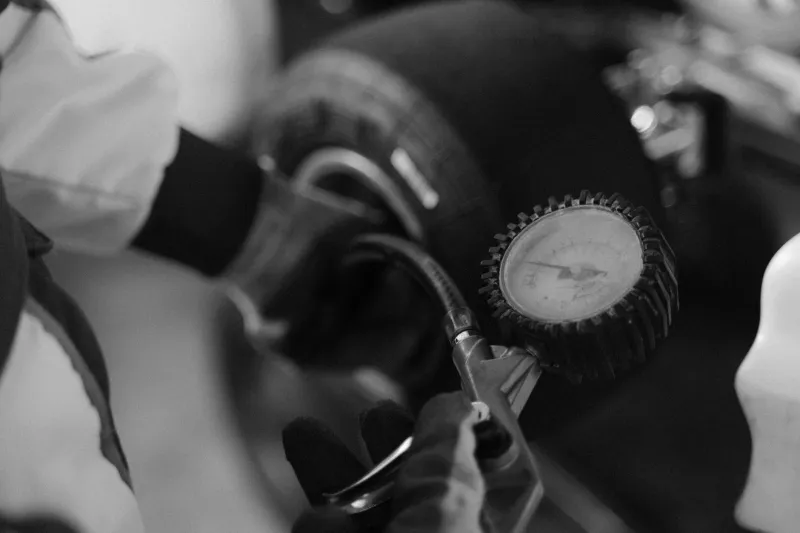
A weekly check with a decent gauge — not the one on the forecourt airline that has been dropped forty times — takes two minutes. Unscrew the valve cap, press the gauge squarely, read it, refit the cap. Caps are not decoration: they keep grit and moisture out of the valve. If one is missing, replace it.
Tread: the 20p test and the legal line
UK law requires at least 1.6mm of tread across the central three-quarters of the tyre, around the whole circumference. That is the legal minimum, not a target. For wet UK roads, many drivers replace tyres well before that. Standing water does not care about the letter of the law.
Use the 20p test as a quick visual prompt. Insert a 20p coin into the main grooves. If the outer band of the coin is visible, the tread is getting close to the legal limit. Do it in several places around each tyre, not just one convenient spot. Inner edges are often the first to scrub, especially on cars with a lot of negative camber or a heavy right foot.
Check the tread on all four tyres and, if you have one, the spare. A space-saver has its own pressure and speed limits; read the sidewall rather than guessing.
Sidewalls, valves and the clues you almost miss
Run your hand around the sidewall — gently, and watch for sharp objects. Look for cuts, bulges, cracking and embedded screws. A bulge means the internal structure has been damaged. That tyre is not a wait-and-see item. It needs professional attention before it lets go at speed.
Check the valve stems for cracks and the wheel rims for fresh kerb damage. A slow puncture is often a nail you picked up weeks ago, or a corroded rim seal on an older alloy. If one tyre keeps losing a few psi, stop topping it up and get it looked at. Air is not the problem; the leak is.
TPMS is a prompt, not a pass
If your car has tyre pressure monitoring, the light is a useful nudge. It is not a substitute for a gauge. Some systems are indirect and rely on wheel speed; they can miss a slow loss until it is significant. Others can be triggered by a cold snap, because pressures drop as temperatures fall. Reset the system only after you have set the pressures correctly and read the handbook on how to do it.
Why this matters beyond the obvious
MOT readiness is part of it. Tyres with cuts, bulges, exposed cords or insufficient tread are a clear route to a failure, and you do not want to discover that on the morning of the test. Fuel bills are part of it too: soft tyres waste energy. But the main reason is wet-weather grip. Braking, steering and putting power down all depend on that small contact patch. In a British winter, with leaves, salt and standing water about, a tyre that is 4psi down is not a small detail.
A simple routine
Park on level ground. Check pressures cold. Look at tread with a 20p coin. Scan each sidewall. Refit the caps. Glance at the spare. If something looks odd, deal with it — do not file it under 'later'. Two minutes now is cheaper than a tyre, a wheel and an insurance excess later. Your car will not thank you, but your wallet and your stopping distance might.